VOLUME
ONE
CHAPTER TWO

ST
DUNSTAN'S, BURNHAM-ON-SEA
 In
Chapter One I mentioned a meeting in the Gezirah Sporting
Club (Cairo) in 1917 between my father and Captain Evan Stokes
of the Northamptonshire Regiment which resulted in my brother
Dick going to St. Dunstan's in 1923. He stayed in the school
until 1928, and I went there in 1927, so we had one year together
at the same school. To record that event my mother arranged
for this picture to be taken of the three of us, when I (on
the right) was proudly wearing my St. Dunstan's tie for the
first time.
In
Chapter One I mentioned a meeting in the Gezirah Sporting
Club (Cairo) in 1917 between my father and Captain Evan Stokes
of the Northamptonshire Regiment which resulted in my brother
Dick going to St. Dunstan's in 1923. He stayed in the school
until 1928, and I went there in 1927, so we had one year together
at the same school. To record that event my mother arranged
for this picture to be taken of the three of us, when I (on
the right) was proudly wearing my St. Dunstan's tie for the
first time.
In 1928 Dick went to his public school, Blundell's in Tiverton.
My father had hoped that he would go to his old school, King's
Worcester, where his own father had been headmaster, but Mrs.
Stokes, who had taught at Blundell's and knew the school well,
thought that it would be a better school for him to go to,
where she could keep an eye on him while his parents were
overseas. At Blundell's there occurred another of the strange
coincidences that happen to me so often: the House Dick went
into was 'North Close', where the Housemaster was Mr. E.G.Peirce.
When I left school in 1937 I got a job in a firm of what in
those days was called 'East India Merchants' named Peirce
Leslie & Co. Ltd., and 25 years later, when I was making
a film to celebrate the centenary of the company, I discovered
that the man who founded it in South India in 1862, R.H.Peirce,
was the father of Dick's housemaster, E.G.Peirce, and that
J.E.P.Peirce, a contemporary of mine at St. Dunstan's, was
the son of E.G.Peirce. In other words, Dick was at school
with the son of the founder of Peirce Leslie & Co. Ltd.
and I was at school with the grandson of the founder!
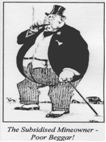 The
only time I saw the school before going there was in 1926,
when the TUC (Trades Union Council) called a General Strike
in an attempt to force the government to pass a law preventing
wage reductions and worsening conditions for coal miners at
a time when owners of coal mines were being subsidised by
the government. This cartoon, which appeared in one of the
papers at that time, shows a remarkable similarity to the
sentiment 82 years later if one substitutes 'Banker' for 'Mineowner'!
The
only time I saw the school before going there was in 1926,
when the TUC (Trades Union Council) called a General Strike
in an attempt to force the government to pass a law preventing
wage reductions and worsening conditions for coal miners at
a time when owners of coal mines were being subsidised by
the government. This cartoon, which appeared in one of the
papers at that time, shows a remarkable similarity to the
sentiment 82 years later if one substitutes 'Banker' for 'Mineowner'!
As there were no train or coach services during the strike,
we had to go by car, so our old friend 'James', the "bull-nose"
Morris Oxford, had to take us. On the journey, to pass the
time we amused ourselves by playing "I spy", and
when we were on the A4 at the outskirts of Reading we were
much amused to espy a notice at a turning off it warning us
that there was "No road past the cemetery".
As 'James' found the journey to Somerset rather tedious (and
so did we), and petrol at a shilling a gallon was so expensive,
for most of the time he was at St. Dunstan's Dick went by
train: my parents used to drive him to Paddington Station,
where a master from the school met all the boys who were coming
by train and put them in the three compartments that had been
reserved for the school and accompany them to Burnham-on-Sea.
My father
was very familiar with Paddington Station, as before he went
out to the Sudan he worked there as Secretary to the General
Manager of the Great Western Railway ("God's Wonderful
Railway") and when he left was given 56 letters in the
handwriting of Isambard Kingdom Brunel which he wrote to Sir
Daniel Gooch, a designer of locomotives who was the Chairman
from 1865 to 1889 and C.A.Saunders, General Superintendent
at about the same time, together with various other documents
concerning the GWR between 1837 and 1857. In 1961 he donated
all these to the "Brunel Collection" at Bristol
University.
My memories of my time at St. Dunstan's start on Platform
1 of Paddington Station in 1927, from where I went by the
same train every term for the following five years.  Seats
were reserved for about twenty of us, and we were met by a
master who accompanied us to Burnham-on-Sea. Before taking
our places we had to put our trunks and tuck boxes into the
luggage van a few carriages away: this is the tuck box I used
82 years ago and still use in the garage, but no longer with
"tuck" in it! In it my mother used to put a few
Cadbury's chocolate bars (costing 2d each), one of her delicious
fruit cakes (which we called "Uncle George"), apples,
oranges and delicacies which were not provided by the school.
Seats
were reserved for about twenty of us, and we were met by a
master who accompanied us to Burnham-on-Sea. Before taking
our places we had to put our trunks and tuck boxes into the
luggage van a few carriages away: this is the tuck box I used
82 years ago and still use in the garage, but no longer with
"tuck" in it! In it my mother used to put a few
Cadbury's chocolate bars (costing 2d each), one of her delicious
fruit cakes (which we called "Uncle George"), apples,
oranges and delicacies which were not provided by the school.
The train to Bristol always left at 11.15, and to be sure
that they were there in good time all parents arrived early,
so there was plenty of time for fathers to have a chat about
their activities and weepy mothers to clutch the hands of
their children, frequently looking at their watches as they
waited for the train to go (which was always on the dot),
when the Guard at the end of the train blew his whistle, waved
his green flag, the engine chuffed, and off we went.
Once we were on our way there may have been a little suppressed
weepiness until we reached Maidenhead, but after that it was
all chat, where we had been for the hols, what our parents
were doing and other exciting things, so we soon forgot about
our weeping mothers (who, at about the same time, were doubtless
recovering and delighted to have a little peace in the house
after the rumpus in holiday time). Although we quickly became
good friends, we never knew each other by our Christian names,
only by our initials, though nicknames were often used. I
was known as "Bolly", which accounts for the title
"Bolly Gazette" describing events in 1930 and 1931,
which I typed on my father's typewriter in the holidays those
years (you will find it on pages 10 to 15 if perchance you
want to see it). In school we were only called by our surnames,
without even initials, thus when Dick and I were there together,
he was "Bolland 1" and I was "Bolland 2")
We had to sit in the compartment that had been reserved for
us because the train on which we travelled made the journey
from Paddington to Bristol non-stop, thus ensuring that they
always arrived exactly on time. Passengers going to Reading,
Swindon and Bath had to travel in "slip coaches"
which were uncoupled from the train while it was in motion
shortly before it reached the station and glided into it under
its own braking. These slip coaches had 1st, 2nd and 3rd class
accommodation (as all trains had in those days) and a brake
section where a guard operated the brakes and had space for
storage of luggage. It was always great fun watching the slip
coaches leaving the end of our train - and listening to the
sound that the train made as the engine scooped up water from
a trench under the rails at Reading as it rushed through the
station.
 At
Bristol our coach was attached to a train going to Taunton,
stopping at Highbridge, where we changed onto the "Slow
and Dirty Jam Roll" (as we called the Somerset &
Dorset Joint Railway) which took us to its terminus at the
end of High Street in Burnham-on-Sea (on the right), from
where, after loading trunks and tuck boxes onto a horse-drawn
cart, we walked to the school. In 1932 the S & D.J.R line
was closed and the station at Burnham ceased to exist.
At
Bristol our coach was attached to a train going to Taunton,
stopping at Highbridge, where we changed onto the "Slow
and Dirty Jam Roll" (as we called the Somerset &
Dorset Joint Railway) which took us to its terminus at the
end of High Street in Burnham-on-Sea (on the right), from
where, after loading trunks and tuck boxes onto a horse-drawn
cart, we walked to the school. In 1932 the S & D.J.R line
was closed and the station at Burnham ceased to exist.
 This
is one of the trains from Paddington to Bristol, pulled by
a "Castle" class engine from 1927 until 1930, when
they were replaced by engines of the "King" class
which looked very similar. We got to know the names of many
castles and kings as we all kept books in which we recorded
the names of the engines which took us, or which we saw in
the stations we passed through. We were amazed to see how
many castles there were in the British Isles.
This
is one of the trains from Paddington to Bristol, pulled by
a "Castle" class engine from 1927 until 1930, when
they were replaced by engines of the "King" class
which looked very similar. We got to know the names of many
castles and kings as we all kept books in which we recorded
the names of the engines which took us, or which we saw in
the stations we passed through. We were amazed to see how
many castles there were in the British Isles.
Most of the 70 or so boys at St. Dunstan's at that time were
boarders, and many of their parents had jobs overseas - in
India, Ceylon, Malaya, Kenya, Rhodesia, Hong Kong and other
places - in the army, in Government Services, shipping companies,
banks and insurance agencies or as tea, coffee or rubber planters
and many other activities.
Parents living overseas who had boys at prep schools in England
depended very much on the headmaster, and particularly on
his wife. My parents were very impressed with and put a lot
of trust in Captain and Mrs. Stokes, as did all the other
parents: this undoubtedly accounts for the success of the
school in the 1920s, 1930s and 1940s. Their friendship with
Hilda and Evan Stokes continued long after I left the school,
and resulted in my marriage to Peggy Stevens 30 years later!
That is another story which I will record when I come to Volume
4 ("Married Life").
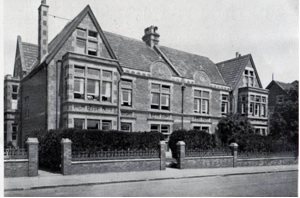 This
is St. Dunstan's School in Grove Road as I knew it (and indeed
as it still is). The lower windows on the left were the headmaster's
study (the first time I went into it I was alarmed to see
in one corner several long canes. Like other boys who had
misbehaved I received 'six of the best' from him on two occasions
- doubtless well deserved - and 80 years later am none the
worse for that!) Every Sunday evening senior boys spent an
hour or so in the study, where we sat on the floor as the
headmaster read books to us - in my last term it was Thomas
Hardy's "The Mayor of Casterbridge".
This
is St. Dunstan's School in Grove Road as I knew it (and indeed
as it still is). The lower windows on the left were the headmaster's
study (the first time I went into it I was alarmed to see
in one corner several long canes. Like other boys who had
misbehaved I received 'six of the best' from him on two occasions
- doubtless well deserved - and 80 years later am none the
worse for that!) Every Sunday evening senior boys spent an
hour or so in the study, where we sat on the floor as the
headmaster read books to us - in my last term it was Thomas
Hardy's "The Mayor of Casterbridge".
The other windows on the ground floor were classrooms with
blackboards and desks in lines, on which generations of boys
had carved their names - as of course I did. The walls of
the corridors and classrooms were painted dark brown up to
about four feet, presumably so that they wouldn't show our
grubby finger marks and therefore rarely needed repainting!
We were taught by highly qualified masters. In addition to
Captain Stokes I should mention Mr. Philip Farr-Cox, maths
master who came to the school in 1929 and apart from a period
of war service, continued to teach until his death in 1965,
Mr. Morgan, our French teacher, the red-headed ex policeman
Mr. Skittery and Mr. H.G.Potts who came to the school in 1931,
and stayed for thirteen years: he was senior master for eleven
years.
On the first floor were the dormitories, each having anything
from six to ten beds, bathrooms, lavatories (as they were
called then, never "toilets" which was too vulgar
a word for middle-class boys to use!) and the "sick room"
for boys with 'flu and other minor health problems. To keep
us on the move regularly we were given a teaspoonful of syrup
of figs once a week, and if we just had a bad cold we had
to bathe our feel in a bowl of boiling water with eucalyptus
leaves in it. In my time I was lucky enough to be looked after
by three splendid matrons at various times - Miss Austin,
Miss Bishop and Miss Bassett. There were no curtains and no
carpets on the floors and it wasn't until my second year that
electricity was installed in the dormitories (prior to that
all lighting was by gas). The sea shore was only about 200
yards from the front of the building, and when the wind was
strong (as it often was) it came right through the windows
- as did the rain! Indeed there were no luxuries in those
days and the accommodation would not have been tolerated by
parents of the 21st Century.
 Members
of the teaching staff lived in a house a few doors away on
the right of this picture, and on the left was "Sandown"
where Mrs. Fletcher (Mrs. Stokes's mother) lived, in the garden
of which we were encouraged to plant flowers and vegetables
and compete for a prize every year (a cheap way for Mrs. Fletcher
to keep her garden tidy and well planted!). I won the "Garden
Prize" in my last term (Summer 1932). The prize was Rudyard
Kipling's "Kim": this is the book plate in it, in
the Headmaster's handwriting (on that occasion I was honoured
with initials to my name!).
Members
of the teaching staff lived in a house a few doors away on
the right of this picture, and on the left was "Sandown"
where Mrs. Fletcher (Mrs. Stokes's mother) lived, in the garden
of which we were encouraged to plant flowers and vegetables
and compete for a prize every year (a cheap way for Mrs. Fletcher
to keep her garden tidy and well planted!). I won the "Garden
Prize" in my last term (Summer 1932). The prize was Rudyard
Kipling's "Kim": this is the book plate in it, in
the Headmaster's handwriting (on that occasion I was honoured
with initials to my name!).
Opposite the school was the Headmaster's house, "Sandy
Lodge" in which there was a small dormitory for the most
senior boys in their last year. I occupied one of these for
my last two terms. The spare room of Sandy Lodge was used
as an additional sick room when it was necessary to segregate
boys with infectious diseases like German measles, whooping
cough and chicken pox, which we all had at various times.
There were several cases of mastoids and occasionally one
of scarlet fever, which had to be sent to the isolation hospital
at Axbridge. The most exciting medical event in my time was
the occasion when Patrick Stokes, the elder son of the headmaster,
was rushed off to London to have a kidney removed!
 At
the back of the school was the Dining Hall detached from the
main building, in which all meals were served. Behind it was
the kitchen, with a glass roof over the passage to the Dining
Hall. On one stormy day in 1931, while we were having tea
a tall chimney fell onto the glass roof and shattered it.
At
the back of the school was the Dining Hall detached from the
main building, in which all meals were served. Behind it was
the kitchen, with a glass roof over the passage to the Dining
Hall. On one stormy day in 1931, while we were having tea
a tall chimney fell onto the glass roof and shattered it.
This was
an exciting event for us to tell our parents in the letters
we had to write to them every Sunday evening. (I am sure that,
because of this compulsory writing habit, I automatically
wrote to my mother almost every week from the time I went
into the army in 1939 until my marriage in 1957).
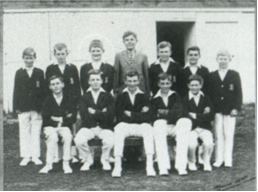
On the walls of the Dining Hall were photographs of football,
rugby and cricket teams. These two were of the 1932, the 1st
XV rugby team and 1st XI cricket team. I wasn't good enough
to play in the 1st X1, but I am in the picture because I was
the team scorer that year. (If you want to see what I was
like in my last year at St. Dunstan's, you will find me third
from the left in back row in the picture on the left and in
the centre of the back row in one on the right).

On the
right of the Dining Hall was the Gymnasium in which a short
service was held every morning and in which the end of term
service was held (happy memories of "Lord dismiss us
with thy blessing" which we sang with much gusto!). The
Gym was also used for "lantern lectures", film shows,
talks, prize-giving and other events. 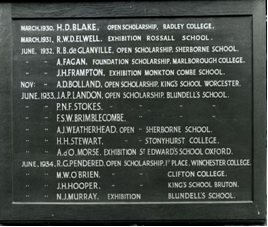 On
its walls were the Honours Boards containing details of scholarships.
These recorded that 179 scholarships to 47 different public
schools all over the country were won between 1923 and 1978
(my name appears on this one for 1932). In additional to the
scholarships, year after year there was a remark in the School
Magazine that "All our Common Entrance candidates were
successful". I mention these details to record what an
excellent reputation St. Dunstan's had for education, making
it one of the best prep schools in the country. Scholarships
were specially happy events for everyone in the school, for
each one was celebrated with a trip to Brean Down with a picnic
on the top in the summer term.
On
its walls were the Honours Boards containing details of scholarships.
These recorded that 179 scholarships to 47 different public
schools all over the country were won between 1923 and 1978
(my name appears on this one for 1932). In additional to the
scholarships, year after year there was a remark in the School
Magazine that "All our Common Entrance candidates were
successful". I mention these details to record what an
excellent reputation St. Dunstan's had for education, making
it one of the best prep schools in the country. Scholarships
were specially happy events for everyone in the school, for
each one was celebrated with a trip to Brean Down with a picnic
on the top in the summer term.
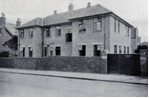 In
1930 there was great excitement when we watched a new house
being built a short distance at the back of the school premises,
in which there were two more classrooms, a laboratory and
two dormitories. With great originality it was called "New
House": this is what the front of it looked like from
Allendale Road (which runs parallel to Grove Road). It was
opened in 1931, with another splendid matron, Mrs. Peddleston.
In
1930 there was great excitement when we watched a new house
being built a short distance at the back of the school premises,
in which there were two more classrooms, a laboratory and
two dormitories. With great originality it was called "New
House": this is what the front of it looked like from
Allendale Road (which runs parallel to Grove Road). It was
opened in 1931, with another splendid matron, Mrs. Peddleston.
For some us it wasn't the school buildings that were important,
it was the magnificent playing field of 7 acres, about half
a mile away, to which we walked every day, apart from Sunday,
to take part in games of football in the Christmas term, rugby
in the Easter term and cricket or tennis at the nearby Avenue
Tennis Club once a week in the summer term or to watch our
teams playing matches.
When there were home matches on, if we were not playing in
them, we watched our teams (of which there were five) playing
against other schools. Just for the record, the prep schools
we played were Clarence, Colchester House, Connaught House,
Etonhurst, Naish House, XIV, Hill Brow and St. Peter's, all
of which ceased to exist before 1983, when St. Dunstan's also
had to close down. The sad disappearance of these schools
was partly due to the fact that after the war the government
ceased giving grants to parents working overseas who had boys
in prep schools in the UK, and partly because there were more
holidays in term time when boys were allowed to go home at
a time when petrol had become very expensive, resulting in
parents preferring their children to go to schools near their
homes, often as day boys, as Schools in Somerset were too
far away for them to travel.
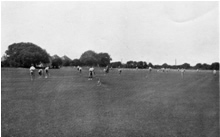
The two pictures on the left, taken from the Prospectus in
the 1930s, show the spacious playing field as it was when
I knew it: the satellite picture on the right shows the same
area as it became a few years after the school closed in 1982.


It
was on this playing field that St. Dunstan's boys built up
a remarkably good record for sporting activities year after
year. The school magazines record that from 1926 to 1975 in
cricket we played 627 matches against other prep schools of
which we won 444 and drew 320, in soccer we played 426 and
won 293 with 38 draws, and in rugby we played 393, won 248
and drew 9. Thus in these 49 years the school won 68% of all
matches played.
In the summer term, the big event was the 'Father's Match'
at half term when a team of parents played the school first
eleven, and there was an excellent tea in the pavilion (indeed
at all the cricket matches with other schools there were always
'team teas' in the pavilion for the teams who played in the
home matches, provided by Mr. and Mrs. Rolfe who did the catering
at the school for 21 years (from 1926 to 1947).
On 5th November (Guy Fawkes Day) each year we all walked to
the playing field to watch a super firework display put on
by the staff. In the "Bolly Gazette" of 1930 I recorded
an exciting event that happened that year in the following
rather lurid words "On Wednesday, November the fifth,
whist the school was watching a most excellent display of
fireworks, a "Whiz-Bang" happened to fall in a small
box of fireworks. In this box of fireworks there was a rocket,
and having been lighted by the "Whiz-Bang" at once
went off, unfortunately, Mr Tregelles was caught by this firework,
in the face. He was taken to the hospital, and had to have
stitches put into his face".
When the playing fields became impossible to play on because
they were flooded or covered in snow (as quite often happened
- in those days schools didn't close every time there was
a snowfall!) matches had to be cancelled, and we played games
on the beach just below the school, which also provided an
excellent place on which to play hockey in the Easter term.
We also used the beach during the 11 o'clock break every day,
after being given a glass of milk, when regardless of the
weather we had to run out onto it to play and get fresh air.
The Burnham climate was described in the School Prospectus
of 1932 as "one of the most bracing in the Kingdom"
with the statement that "Burnham is a particularly healthy
place for young children with its vast stretches of sand and
miles of sand-hills, of which full advantage is taken for
sand games during spare time". On Saturday evenings,
when the days were long enough, we were indeed allowed to
play in the sand dunes, where we had great fun, returning
to school covered in sand.
On Sundays we had to wear our best suits and 'Eton Collars'.
In this smart attire we walked in a 'crocodile' to St.Andrew's
Church for the morning service, taken by the vicar (in my
time it was Hereward Wake), where Mrs. Feaver played the organ
from 1924 to 1952 (and often invited us to tea in her house
in the Esplanade on Sunday afternoons). We sat in the gallery
and took the collections, and senior boys had to read the
lessons. Every Sunday afternoon we walked about 3 miles to
the little church at Edithmead, which we knew as the 'tin
tabernacle'.
 Other
expeditions included going to Brent Knoll when Good Friday
was in term time, where we climbed the Knoll and eat hot cross
buns at the top. We also went to Brent Knoll at 'conker' time
as there was an avenue of splendidchestnut trees under which
we picked up the biggest ones we could find, took them back
to the school and threaded them onto pieces of string so that
we could have really tough conker fights (in those days conkers
were not considered a risk to our safety, so nobody ever thought
of giving us tin hats to wear!).
Other
expeditions included going to Brent Knoll when Good Friday
was in term time, where we climbed the Knoll and eat hot cross
buns at the top. We also went to Brent Knoll at 'conker' time
as there was an avenue of splendidchestnut trees under which
we picked up the biggest ones we could find, took them back
to the school and threaded them onto pieces of string so that
we could have really tough conker fights (in those days conkers
were not considered a risk to our safety, so nobody ever thought
of giving us tin hats to wear!).
 As
far as relaxation was concerned, in addition to the books
that the headmaster used to read to us on Sunday evenings,
we were allowed to use his portable HMV gramophone twice a
week, on which we played the latest HMV, Columbia or Decca
records of Gracie Fields or Harry Lauder (this is what I referred
to as "The B.B.C.Wireless" in "The Bolly Gazette").
I would have loved to have a gramophone at home, but it was
too expensive (£6) and I had to wait until 1930 when
the price was reduced because electric record players were
coming onto the market.
As
far as relaxation was concerned, in addition to the books
that the headmaster used to read to us on Sunday evenings,
we were allowed to use his portable HMV gramophone twice a
week, on which we played the latest HMV, Columbia or Decca
records of Gracie Fields or Harry Lauder (this is what I referred
to as "The B.B.C.Wireless" in "The Bolly Gazette").
I would have loved to have a gramophone at home, but it was
too expensive (£6) and I had to wait until 1930 when
the price was reduced because electric record players were
coming onto the market.
This reference to prices has reminded me of the school Prospectus
for 1930 in which it was recorded that the 'inclusive fee'
for boarders was £38 per term plus £1.12s per
for Sickness and Accident Insurance, 2½ guineas for
Music, 10/6 for Shooting, 10/6 for Boxing, one guinea for
Dancing and 10/6 as Tennis Club Subscription. For day boys
the 'inclusive fee' was 12 guineas per term plus 15/6 Sickness
and Accident Insurance, 3½ guineas for Dinners at School
and 1½ guineas for Teas. Fifty years later, when I
was a governor of the school (which became a Charitable Trust
in 1972), we were discussing the affect that another increase
in school fees might have on prospective parents, and one
of the governors, who was at the school about twenty years
after I was and whose father had been a farmer, remarked that
when he was at school his father told him that when he was
in the school it cost "a cow and a half" to keep
him at the school for a term, and the higher fees being discussed
would still be only equivalent to a cow and a half!
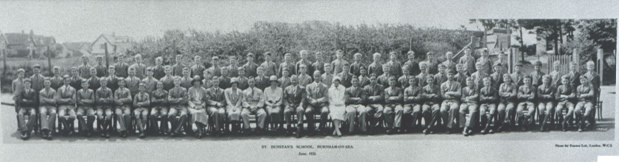
 Every
summer term a school photograph was taken: this is the 1932
photo: in the centre of the front row are Mr. Farr-Cox, Captain
& Mrs. Stokes, Mr. Potts and Miss Bassett (matron).The
photographs were taken with a "panoramic" camera
like this which started on the right and slowly moved round
to the left: if one was standing on the right one had an urge
to rush to the left when the camera was in the centre, and
thus appear twice in the same picture. This idea was attempted
once, but was frowned on by the Headmaster who threatened
"six of the best" to anyone who tried to do it again!
Every
summer term a school photograph was taken: this is the 1932
photo: in the centre of the front row are Mr. Farr-Cox, Captain
& Mrs. Stokes, Mr. Potts and Miss Bassett (matron).The
photographs were taken with a "panoramic" camera
like this which started on the right and slowly moved round
to the left: if one was standing on the right one had an urge
to rush to the left when the camera was in the centre, and
thus appear twice in the same picture. This idea was attempted
once, but was frowned on by the Headmaster who threatened
"six of the best" to anyone who tried to do it again!
The only occasion that we were allowed out of the school was
half term, when parents came to Burnham to take their boys
home for the day (if they didn't live far away). Those of
us who lived too far away to go home were taken out by their
parents: in my case the first stop was usually Woolworths,
the "threpenny and sixpenny store" where nothing
cost more than 6d, then to the Bluebird café (which
later became the International Stores and is now the 'Job
Centre') for a super tea as we listened to the orchestra of
two violins  and
a piano playing popular music, and finally, as a special treat,
a visit to the cinema half way down the High Street. This
is what it looked like in 1920, but it was much the same when
I knew it. When I first went there (with other senior boys
on special occasions the films were all silent, but I was
lucky enough to be in Burnham when the first "talkie"
was produced during my first term - Al Johnson in "The
Jazz Singer". That was a most exciting development in
the history of "movies", but it was some time before
it got to Burnham.
and
a piano playing popular music, and finally, as a special treat,
a visit to the cinema half way down the High Street. This
is what it looked like in 1920, but it was much the same when
I knew it. When I first went there (with other senior boys
on special occasions the films were all silent, but I was
lucky enough to be in Burnham when the first "talkie"
was produced during my first term - Al Johnson in "The
Jazz Singer". That was a most exciting development in
the history of "movies", but it was some time before
it got to Burnham.
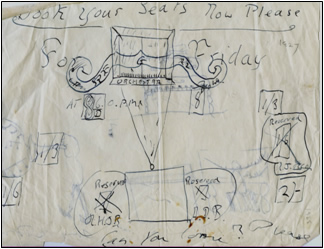 Although
we were never allowed to leave school for a single night at
any time during term-time, we had three good holidays a year
- one month between the Christmas and Easter terms, one month
between the Easter and Summer terms, and two months from the
end of the summer term to the start of another new school
year at the beginning of the Christmas term. The long summer
holidays became a bit of a bore unless one developed a hobby
to keep one busy, and it was in 1929 that I started on my
new hobby of giving film shows initially in my home ("The
Heights", described in Chapter One) and later in the
village hall. Although "talkies" had just started
being shown in cinemas all over the country, the films I showed
were of course silent. This is the invitation I sent to my
friends to publicise the first show (showing the seats that
were reserved for Dick and me on either side of the projector
and one for my mother on the right!). The projector was an
ancient hand-cranked machine with 30 ft reels of 35 mm film
which lasted for about 12 minutes each.
Although
we were never allowed to leave school for a single night at
any time during term-time, we had three good holidays a year
- one month between the Christmas and Easter terms, one month
between the Easter and Summer terms, and two months from the
end of the summer term to the start of another new school
year at the beginning of the Christmas term. The long summer
holidays became a bit of a bore unless one developed a hobby
to keep one busy, and it was in 1929 that I started on my
new hobby of giving film shows initially in my home ("The
Heights", described in Chapter One) and later in the
village hall. Although "talkies" had just started
being shown in cinemas all over the country, the films I showed
were of course silent. This is the invitation I sent to my
friends to publicise the first show (showing the seats that
were reserved for Dick and me on either side of the projector
and one for my mother on the right!). The projector was an
ancient hand-cranked machine with 30 ft reels of 35 mm film
which lasted for about 12 minutes each.
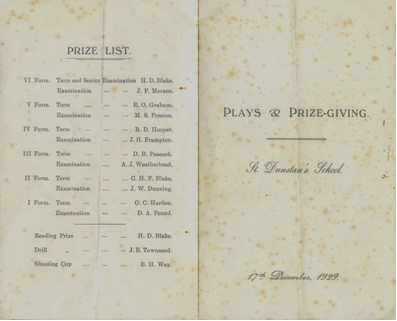
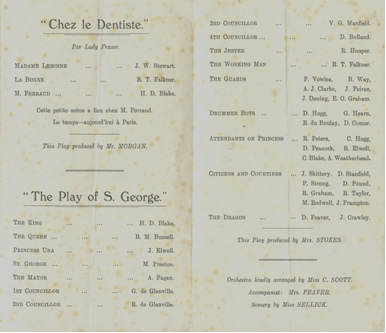
Back at
school after that summer holidays I rehearsed for a performance
in one of the plays Mrs. Stokes used to produce at prize-giving
in the winter term (often with a French play produced by our
French teacher, Mr. Morgan). This is the prize list and programme
for the 1929 performance (you will notice that I was not among
the prize winners, but that isn't surprising as I was never
much of a scholar at school, and in several school reports
the headmaster described me as "a good plodder"!).
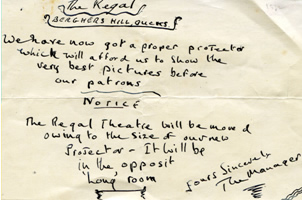
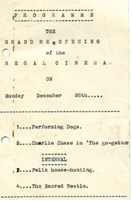
In the
following Easter holidays my father took me to meet an old
friend of his who lived in a large house near the Zoo in Regents
Park (Mrs. Tetley, the wealthy widow of the founder of Tetley's
Tea) who to my delight gave me the enormous tip of two half
crowns (5 shillings, equivalent to 25p) when we left. Thanks
to her generosity I was able to buy another second hand projector
for my cinema (which I called "The Regal"). This
was the notice I sent out to my "customers" when
I reopened the cinema in the Christmas holidays, and the programme
I typed for the "grand reopening":
And
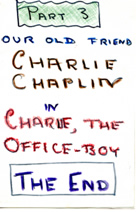
here are the posters I drew for the show I gave in the Christmas
holidays in 1930:


 I
have mentioned all this to indicate how busy I was during
the holidays. Returning to term time at St. Dunstan's, I recall
the various crazes we had there, many of which were originated
by the Daily Mirror, our favourite paper at that time as in
it was a children's section which contained a cartoon of Pip
(a dog) Squeak (a penguin) and Wilfred (a baby rabbit). "Pip,
Squeak and Wilfred" were hugely popular everywhere, even
Queen Mary was said to be one of its greatest fans, and my
favourite book for Christmas was always the Pip and Squeak
Annual.
I
have mentioned all this to indicate how busy I was during
the holidays. Returning to term time at St. Dunstan's, I recall
the various crazes we had there, many of which were originated
by the Daily Mirror, our favourite paper at that time as in
it was a children's section which contained a cartoon of Pip
(a dog) Squeak (a penguin) and Wilfred (a baby rabbit). "Pip,
Squeak and Wilfred" were hugely popular everywhere, even
Queen Mary was said to be one of its greatest fans, and my
favourite book for Christmas was always the Pip and Squeak
Annual.
 As
Pip, Squeak and Wilfred fans, we all joined the 'Wilfredian
League of Gugnuncs' and proudly wore this blue enamel badge
(The name "Gugnunc" came about because, unlike Pip
and Squeak, Wilfred spoke only in baby-talk and "gug"
and "nunc" were his favourite words). Believe it
or not, every year Gugnuncs all over the country held parties
and meetings and an annual rally at the Royal Albert Hall
to raise money for children's hospitals and charities.
As
Pip, Squeak and Wilfred fans, we all joined the 'Wilfredian
League of Gugnuncs' and proudly wore this blue enamel badge
(The name "Gugnunc" came about because, unlike Pip
and Squeak, Wilfred spoke only in baby-talk and "gug"
and "nunc" were his favourite words). Believe it
or not, every year Gugnuncs all over the country held parties
and meetings and an annual rally at the Royal Albert Hall
to raise money for children's hospitals and charities.  Gugnuncs
also used a sign language when talking to each other: when
one met a friend for the first time in the day one said "ick
ick pa
Gugnuncs
also used a sign language when talking to each other: when
one met a friend for the first time in the day one said "ick
ick pa  boo"
and put one's hands together like this the reply to which
would be "goo goo pa nunc " like this
boo"
and put one's hands together like this the reply to which
would be "goo goo pa nunc " like this
 There
were two other crazes at that time. One was to wear this enamel
Golliwog badge which our parents collected from vouchers in
jars of Robertson's marmalade and jam, some of which we all
wanted our mothers to include in our tuck boxes - a very clever
bit of advertising by the firm. (Reference to a Gollywog is
now considered racist, but nobody had thoughts like than in
those days).
There
were two other crazes at that time. One was to wear this enamel
Golliwog badge which our parents collected from vouchers in
jars of Robertson's marmalade and jam, some of which we all
wanted our mothers to include in our tuck boxes - a very clever
bit of advertising by the firm. (Reference to a Gollywog is
now considered racist, but nobody had thoughts like than in
those days).
The other was to collect cigarette cards which Wills, Gallahers,
Three Castles and many other cigarette manufacturers inserted
in packets of 10 or 20 Virginia cigarettes to boost their
sales. The cards, which were in sets of cricketers (Hobbs,
Sutcliffe and Larwood were the most popular), footballers,
film stars, trains, famous buildings and other subjects were
beautifully coloured and printed. The object was to collect
a complete set of 25 or 50 cards, achieved by persuading one's
parents to smoke as much as possible and swapping ones we
already had with those of other boys. Unfortunately there
were no cards in Balkan Sobranie cigarettes, which my parents
preferred, so they weren't much use to me!
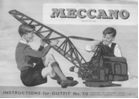 Every
November I and several others wrote to Gamages, asking for
a copy of their Christmas catalogue, which we opened with
great excitement when it arrived. From them we looked up things
we hoped to get as Christmas presents, the smaller ones in
our stockings and the larger under the Christmas tree. The
things we wanted most were Bassett-Lowke model trains, Meccano
sets with which we could make aeroplanes and cars and "Bayko",
with its bakelite bricks with which one could build houses.
There were so many very exciting things for us to do in those
pre-television and computer days.
Every
November I and several others wrote to Gamages, asking for
a copy of their Christmas catalogue, which we opened with
great excitement when it arrived. From them we looked up things
we hoped to get as Christmas presents, the smaller ones in
our stockings and the larger under the Christmas tree. The
things we wanted most were Bassett-Lowke model trains, Meccano
sets with which we could make aeroplanes and cars and "Bayko",
with its bakelite bricks with which one could build houses.
There were so many very exciting things for us to do in those
pre-television and computer days.
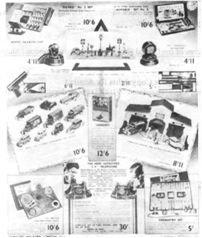 This
is a page from one of the Gamages catalogues in the 1930s
showing the prices of toys in those days (top left was an
advertisement for Bayko). The first thing I wanted to do when
I got home for the Christmas holidays was to go to Gamages
to see some of these things and drop hints to my mother, so
after breakfast we drove to Beaconsfield station, where we
left the car (unlocked as cars didn't have locks in those
days), took an LNER train to Marylebone and the underground
to Holborn station, from where we walked 500 yards or so to
Gamages, which was described as "a maze of rooms, steps,
passages and ramps". After staying there for about half
an hour we took a bus to Regent Street to see what the more
up-market toy shop of Hamley's had to offer. Somewhat weary
after these expeditions, we usually went to the Lyons Corner
House for lunch (served by a "Nippy"), and then
took another bus to Baker Street to go to Madame Tussauds,
where the first thing I wanted to see was the Chamber of Horrors.
By the time we got home, after an exciting and exhausting
day, my mother had no difficulty in persuading me to go to
bed immediately after supper.
This
is a page from one of the Gamages catalogues in the 1930s
showing the prices of toys in those days (top left was an
advertisement for Bayko). The first thing I wanted to do when
I got home for the Christmas holidays was to go to Gamages
to see some of these things and drop hints to my mother, so
after breakfast we drove to Beaconsfield station, where we
left the car (unlocked as cars didn't have locks in those
days), took an LNER train to Marylebone and the underground
to Holborn station, from where we walked 500 yards or so to
Gamages, which was described as "a maze of rooms, steps,
passages and ramps". After staying there for about half
an hour we took a bus to Regent Street to see what the more
up-market toy shop of Hamley's had to offer. Somewhat weary
after these expeditions, we usually went to the Lyons Corner
House for lunch (served by a "Nippy"), and then
took another bus to Baker Street to go to Madame Tussauds,
where the first thing I wanted to see was the Chamber of Horrors.
By the time we got home, after an exciting and exhausting
day, my mother had no difficulty in persuading me to go to
bed immediately after supper.
In the 1930 summer holidays it was too light to give film
shows, so my father, having taught me how to type, lent me
his typewriter on which I started typing the first pages of
"The Bolly Gazette" which covered what I considered
to be the most exciting events of that year and 1931. This
is the first page as I typed it, but as it is difficult to
read I have retyped the whole thing verbatim in a more readable
way, which you will see in the next five pages.

The Bolly Gazette
1930
The Boat Race
The first important fact that occurred in 1930 was the annual
Boat race, run between the two universities, Oxford and Cambridge.
But this year, as last, the cambridge university won. It was
very exciting because sometimes Oxford were ahead, and sometimes
Cambridge were.
The
Cup Final at Wembley
In 1930
the Arsenal won the F.A.Cup final at Wembley. They were playing
against The Huddersfield Town. The score was 2-0.
The
Derby
In
1930 Blenheim (owned by the Aga Khan) Won the Derby. The race
was most exciting in parts.
The
Miss England Tragedy
Whilst
braking the world's record on sea, at lake windermere, Sir
Henry Segrave lost his life. The tragedy was seen by many
people who were looking.
Tragic
mine disaster in Germany
Over two
hundred people were killed at Alsdorf, in Germany. The whole
of the inside, and the outside of a mine was blown absalutaly
to small pieces. Thirty eight (or more) coffins were employed
for carrying the lorries. During the time of this dreadful
mine disaster, the whole of Germany was in mourning.
High
Tides at Burnham
Many troubles were caused when the sea at Burnham, when the
tide came in very high. Many animals were washed up by the
sea.
England's
New Princess
On thursday
October the Eighth, amidst a dreadful thunderstorm, Princess
Margaret rose was born, at Glamis castle, in Scotland. She
was christened in the private chapel, at Buckingham Palace.
And the Golden font was filled with sacred water from the
river Jordan.
The
Meopham Air crash
A few
well known people lost their lives at Meopham in Kent, when
a plane crashed, which was coming over from France. Among
the victims were Lady Ednam, Colonal Ward, and Mrs Loeffler.
The
Test Match
England
won the first test match at Nottingham. But Australia finally
took the ashes home, captained by W.W.Woodful, half due to
the magnificent batting of D.G.Bradman, who made a record
score.
Grand
Ceremony for the Coronation of "The King of King's"
Ras Tafari,
Ethiopia's new emperor, was crowned amidst a great crowd,
at Addis Ababa. His Majesty the King of England was represented
by His Royal Highness, the Duke of Gloucester, who wore the
full dress uniform of his regement, the 10th Hussars. The
Abyssinian National anthem was played, whilst the whole of
Addis Ababa stood still.
The
Dornier D.O.X
The Giant
German plane, The Dornier D.O.X., came to visit England on
the first step of her "Cross atlantic flight" she
came to Calshot. But, Unfortunatly, whilst she was landing
at Lisbon, the capital of France, Portugal, her wing caught
fire, and it took quite a long time to be mended.
The
King & Queen Open Parliament
Their
Majesties the king and Queen of England has a great ceremony
when they opened parliament. Many dazzling uniforms of the
unifoIndian princes added to the beautiful appearance of this
lovely day. His majesty made a speech which was heard both
at the Round table conference and also at the Indian Conference.
The
Tragedy of the Meuse Valley
More than
fifty deaths occurred in Belgium on December the fifth, when
suddenly a fog came down onto the valley of the Meuse. It
appeared to be a kind of poison gas, which had ascended into
the valley, the kind which they had in the great War. Over
fifty men, women and children died from this most dreadful
poison fog.
Sad
Fate of the world's largest Airship
All the
world mourned at the sad fate of the World's largest airship,
the R.101. She was said to be flying very low , when suddenly
a gust of wind caught her, at that she came up, only to be
caught once more, but one more she came up, only this time
she was hit down so heavily that she hit the ground. --- Then
she burst into flames…. and so ended the world's largest airship.
The french behaved with such magnifiscence that they were
given various medals and honors. The dreadful accident occured
at a place called Allon, near Bauvais, the town of the middle
ages.
The coffins came over in SS Tiburne and S.S.Hibernia. but,
unfortunately, just as they were starting, one of the boats
refused to work, and in consequence, all the coffins had to
be placed on the one remaining boat. They were transferred
to England and were buried in the common gave at Cardington.
WOMEN
CHAMPIONSHIPS 0F 1930
Miss
Amy Johnson
Miss Amy
Johnson flew to Australia in Days. If it was not for sheer
bad luck in India, she probably would have beaten Bert Hinkler's
record of Days. When she came back to London, the whole of
the place burst into excitement, and gave her money, Motor-Cars,
and Aeroplanes &c.
Miss
Diana Fishwick
Miss Diana
Fishwick won the Amateur golf Championship of 1930. She had
a great reception, when she had done this good work.
Miss
Betty Nuthall
In 1930,
Miss Betty Nuthall took the Woman Championship from the United
States of America.
SCHOOL REVIEW OF 1930
Matches
On wednesday,
November the fifth, St Dunstans played a first and second
Eleven match against Naish House. The First easily won, the
score being 8-0. The second eleven also won, the score being
8-2.
On saturday,
November the seventh, St Dunstans drew a match against Clarence
school, the score being 2-2. But an "Under eleven"
match was played against the same school, the score was 9-0.
The St Dunstans team easily winning.
A match
was played against St Peters (the first match of the Christmas
term, 1930. But unfortunately in this match, St Dunstans lost,
the score being 4-5. But the second eleven made up by winning,
the score being 5-0. This match was played on the ground of
ST Peters, at Weston.
St Dunstan's
first eleven won another match on the home ground, Burnham,
against XIV School. The score was 6-2
The first
and second elevens also won against Etonhurst, on the home
ground. The score in the first eleven was 6-2. The score in
the second was 4-1.
The team usually consisted of the following members
| FIRST
ELEVEN |
SECOND
ELEVEN |
| |
|
| de
Glanville 2 |
Dening |
| ______________ |
______________ |
| de
Glanville 1 |
Manfield |
| Way
|
Fagan |
| ______________ |
______________ |
| Graham
1 (Captain) |
Peacock |
| Bussell
1 |
Clarke |
| Wood
|
Norman |
| ______________ |
______________ |
| STOKES
1 |
PENNY
|
| WILSON
|
HOGG
1 |
| PIERCE
(spelt wrongly, should be Peirce) |
ELWELL |
| TAYLOR
|
HOGG
2 |
| HOOPER
|
LYNDSAY |
The B.B.C.Wireless
Twice
in the Christmas Term, 1930, The B.B.C.Took place in the fifth
form. The first time it went with great success. Cheese, the
laughter clown, played his part well, whilst A.D.Bolland conducted
the Orchestra, consisting of Mr G.R.A.Maphone, and greatly
assisted by various members of the R.E.Cord Family. Many people
came to the first house, but rather unfortunately, owing to
the fact that Cheese had to go away, the second house was
not such a success. There had to be more Orchestral items
instead of Comical Talks.
A
Lecture on the tower of London
The lecture
on the tower of london, in the Christmas term 1930, was taken
by Mr Pierce. It was very interesting, chiefly noting History
facts, which was rather a nuisance, when the essay came along.
Entertainment
by Mr Bell
On Saturday,
november the first, there was an entertainment, at St Dunstans,
by Mr Bell. Some of the conjuring tricks, which he did were
most exrtaodinary good.
Bad
Firework Accident
On Wednesday,
November the fifth, whist the school was watching a most excellent
display of fireworks, a "Whiz-Bang" happened to
fall in a small box of fireworks. In this box of fireworks
there was a rocket, and having been lighted by the "Whiz-Bang"
at once went off, unfortunately, Mr Tregelles was caught by
this firework, in the face. He was taken to the hospital,
and had to have stitches put into his face.
BY
SPECIAL REQUEST
Criticism
of the French Play.
This play
was most excellently made out by Mr. F.G.M organ. Well acted,
and was a comedy that anybody, knowing the chief fact of the
play, could easily understand, wether they had learnt French
or not.
The
Easter Term, 1931
MATCHES
The first
match of the term , was against St Peters, on February the
14th, on the home ground. St Dunstans won 9-3. On the same
day The Second eleven also played St Peters. They also won,
the score was. 66-0, this score was a record for the second
eleven. The next match was against Queens Taunton Juniors.
In this match, St Dunstans were unfortunatly beaten; the score
was 0-13. This match was played on the Queens Taunton Ground.
The next match was played on the same ground, and was against
XIV School. In this match St Dunstans won 6-3. After this
match came another against Queens Taunton Juniors, on the
home ground. In this match St Dunstans most unexpectedly won.
The score was 9-0. The next match was Om March 11th. It was
against St Peters again. In the first eleven, St Dunstans
Lost. The score was 8-13. On the same day the second eleven
also played St Peters. They just managed to win by on e point.
The score was 18.17. Unfortunately, in these last two matches,
boys of both teams were absent. The last match of the term
was in the second eleven, against Downs School First eleven.
In this match St Dunstans lost. The score was 6-18. Just before
this was an under eleven match. In this St Dunstans won. The
score was 45-0.
The
Shneider Trophy Contest 1931.
The Schneider
Trophy Contest 1931, was run on September 13th. Unfortunately
just at the last moment, our Two greatest competitors, France
and Italy backed out, much to the disappointment of the British
team. The Contest was won by Great Britain, by Bothman, and
also Flight Lieutenant Stainforth beat the Three kilometre
record with an average speed of 379 M.P.H. Boothman incidentally
beat the lap record. The Contest had to be run on Sunday,
as it rained all day on Saturday.
RAILWAY
EXPRESS RECORD BROKEN
"The
Cheltenham Flyer" broke the railway speed record on Monday,
September 14th. A speed of 80 M.P.H. was reached at one point.
WATER
SPEED RECORD BROKEN
In the
race between Commodore Gar Wood, and Kaye Don, Kaye Don's
boat, Miss England 11, sunk, when it got caught in the wash
of Miss England 11. Kaye Don had a miraculous escape and escaped
without injury.
SCHOOL
NEWS
The weather
during the Summer Term, 1931, has not been exactly pleasing.
Many matches during the term were abandoned, owing to rain.
Also, not only matches, but many ordinary practice games of
cricket had to be abandoned for the same reason. The 3rd,
4th and 5th eleven matches had to be abandoned owing to rain,
much to everybody's disappointment. Many of the usual "beaches"
on Saturday evenings had to be abandoned, and indoor games
had to be played instead. For part of the term, it rained
so hard that the field was unplayable for some time, and games
on the beach had to be played instead.
Owing to chicken-pox and cold weather, the school was unable
to have any bathes at all.
Chicken-pox was also one of the causes of many matches having
to be scratched. A good percentage of the school were stricken
with the discease, and some people quite enjoyed themselves,
during there leave of absence.
In the
summer term of 1932 I passed my Common Entrance Exams and
sat for a scholarship at King's School, Worcester, which I
joined in the Christmas term. In November it was announced
that I had been awarded a scholarship, so from then on I was
a "King's Scholar".
I will describe my life at King's from then until 1937 in
the next Chapter, but before doing so I am taking the liberty
of adding, for those who have not seen it, the text of the
address I gave in St. Andrews Church, Burnham-on-Sea, at the
Service of Thanksgiving for St. Dunstan's School on 16th July
1983 as it is unlikely that anyone will be interested in writing
the history of the great boys' preparatory school which flourished
for 85 years from 1897 to 1982..

Address by David Bolland
It is,
to say the least, unusual for a school to organise a Service
of Thanksgiving within two days of its closure: and it is
unusual to have a cheerful service with prayers written specially
for the occasion. But St. Dunstan's was an unusual school,
and the fact that so many of you have come here this very
hot Saturday morning is ample testimony to the love and respect
that we all have for this fine school.
When Captain Stokes retired in the summer of 1952 he wrote
the following in the School Magazine - that splendid chronicle
which from 1926 onwards has kept all of us so closely in touch
with the affairs of the School:
"We
are very proud to have helped in forming the characters
of so m any respected and God-
fearing citizens. It is hard for us to give up our work,
but we are helped by the knowledge
that our School has made for itself a name of which to
be proud. Throughout our days here
we have always had the support of an excellent and loyal
staff, and a set of boys who have
shown themselves ready to work and play hard and cheerfully,
and to enjoy their school-
Days",
Although
that was written 31 years ago it is, I feel, a fitting epitaph
for this sad occasion, and it is right that we should meet
here in St. Andrew's Church, where so many of us worshipped
for so many years, to give thanks to God for all the St. Dunstan's
has
Meant to us throughout its existence.
As the Chairman of the Governors said in his letter to parents
when he announced the closure - "Days and times change,
and a school of this nature cannot stand against the relentless
tide of to-day". We are the victims of inflation and
of a sadly falling Christian, moral and ethical standards
on which the school was founded and on which it flourished
for so many years. Over the last few years we have tried every
trick in the pack to keep the school going, changing from
a boys' prep school the majority of whose pupils were boarders
to a day school for boys and girls and teaching up to 'O'
level, but unfortunately all our efforts have failed .
We are deeply sorry for our most loyal and efficient staff
who have worked so hard, and we do appreciate and sympathise
with them in the difficulties which now face them. We will
do our best to help them. We are sorry for the children whose
education has been interrupted in mid-stream - and for their
parents. But we have had to face up to the realities of the
present situation, and having now faced them we look back
with pride on the achievements of St. Dunstan's.
We have many things to be thankful for, one of which is that
we have managed to last as long as we have, for apart from
the Downs School in Bristol and those prep schools which are
directly linked to public schools, we are the sole survivors
of the many prep schools that flourished in this area in the
pre-war days and which many of you will remember. Clarence,
Colchester House, Etonhurst, Naish House, XIV, Hill Brow,
St. Peter's and Connaught House have all gone. And of the
girls' schools in Burnham, Hart House, Brean Down House, Oakover,
St. Margaret's, Gardenhurst and sadly, La Retraite, have also
gone.
The only
school of our nature now remaining in Burnham is St. Christopher's,
who by a happy coincidence are housed in what used to be Naish
House - our bitter enemies on the playing fields but always
our most friendly rivals. We are glad that the Chairman of
St. Christopher's School Council and the Headmaster have joined
us in this service, and we wish their school a long and successful
future as the last bulwark of the educational and Christian
standards of which we are all so proud. We are also glad that
the Mayor of Burnham has come here to-day, thus underlining
the close and happy association that has existed between the
people of Burnham and St. Dunstan's throughout the years.
Our association with St. Andrew's Church has been very close,
and we all in out turn remember different Vicars - Dupuis,
Robinson and Porcher in the years prior to 1925, Hereward
Wake from 1925 to 1934, Hugh Parnell in that long period of
36 years from 1934 to 1970 and Prebendery Raymond Dean who
has been here for the past 17 years. All of them have taken
a great interest in St. Dunstan's. They have conducted our
end-of-term services and joined in our activities. We have
been part of their Church and they have been part of us, and
it is fitting that Raymond Dean's Son, Timothy, should have
been our last Head Boy.
We remember, too, Mrs Feaver who played the organ here from
1924 to 1952. She was always such a friend of the School,
helping out with lessons from time to time and inviting us
to tea in her house in the Esplanade. And the doctors who
have looked after us so well throughout the years - Dr. Barry,
Dr. Holmes, Dr. Rex Childs for 30 years and in recent time
his son, Dr. David Childs.
But of course our most prominent thoughts to-day must be for
our Headmasters. Little is known about Mr. Herbert Strong
who established St. Dunstan's in 1897, except that he has
been described as 'a real gentleman'. Mr. J.H.Churchill, who
at one time taught at the School, reported in the 1903 edition
of Mate's Guide to Burnham that in that year the School was
flourishing and about to move into new premises, but what
happened after that we don't know. We do know, however, that
in 1908 the Reverend Horace Kirke was teaching two boys in
a house in Stodden's Road and that a few years later he moved
his expanding school bearing the name of St. Dunstan's to
the premises in Grove Road which so many of us remember, and
that at the time of his death in January 1919 there were about
27 boys in the School. We are delighted that his daughter,
Lady Stallard, is with us here to-day.
In the summer of 1919 Captain Evan Stokes, just out of the
Army, came to take over St. Dunstan's , and thus began the
remarkable period of father and son headmastership that has
continued until the present day. Captain Stokes retired in
1952, but three years earlier Mr. Martin had joined him as
a partner and he remained as Joint Headmaster until 1966 -
a period of 17 years in which he gave to the School an unrivalled
experience of all aspects of education and ensured a smooth
transfer between father and son. We thank him for all that
he did for us.
In 1926 there were 70 boys in the School - 43 more than when
Captain and Mrs. Stokes arrived seven years earlier - and
this shows the immediate impact they had on the prosperity
of St. Dunstan's. Through their wide contacts and ever increasing
reputation boys were coming to Burnham from all over the country
and from overseas. Soon there were 90 boys in the School,
most of them boarders, and this was the level at which they
kept it for the rest of their time here.
There is no doubt that it was entirely due to the influence
of Captain and Mrs. Stokes, and their hard work and devotion
to duty and children, that St. Dunstan's became one of the
best prep schools in the land. Their philosophy can perhaps
be best summed up in what Evan Stokes wrote in the School
Magazine in 1935 - "Loyalty, cheerfulness, happiness
and keenness are essential to school life".
By the time he retired, Evan Stokes had served his School
for 33 years, and it is amazing to think that his son, Eric,
has been Headmaster almost as long a period - 31 years. In
1967 he moved the School from the Grove Road premises to the
Gardenhurst property in Rectory Road, which was considered
to be more suitable for a school which was expanding. By 1970
there were 160 boys in the School - 90 boarders and 70 day
boys - but shortly afterwards inflation began to affect the
numbers as school fees inevitably rose to levels which many
could not afford.
In 1972
the School was formed into a Charitable Trust, and only those
of us who have served on the Governing Body can be fully aware
of the agonising decisions that have had to b e made in the
last ten traumatic years to keep the School going in the face
of raging inflation. We have greatly admired the quiet and
efficient manner in which Eric has carried on running the
School in these difficult conditions, but in recent years
the strain has unfortunately affected his health, and the
moment when he had to announce the closure of the School,
first to his mother and then to his loyal and dumbfounded
staff, must have been distressing in the extreme.
Masters are also in our thoughts to-day. All schoolmasters
seem to be characters, at least in the eyes of schoolboys,
and St. Dunstan's certainly had its fair share of characters.
I will not go through the list, but there are five who I think
deserve special mention. First, Mr. H.G.Potts. He was here
from 1931 to 1944 and was Senior Master for eleven years,
acting as Headmaster for one term when Captain Stokes was
unwell. His interest in the work, games and welfare of the
boys was remarkable, and many of us can still picture him
cycling around Burnham and down The Grove, a pair of nail
scissors in his hand with which to manicure his precious cricket
pitch. Then there was Mr. Philip Farr-Cox, who came to the
School in 1929 and apart from a period of war service was
with us until his sudden death in 1965: 36 years of devoted
service during which he taught many of us maths and was for
many years Senior Master. He was one of our famous and popular
characters, as was Mr. J.N .E. Street, with us for 19 years
from 1936 to 1054, when he died tragically on his way to a
cricket match with Clifton Prep School. He was a most successful
teacher of French, he coached all junior games with infectious
energy and he produced many excellent plays.
Then, one who is here to-day and I am sure will not mind my
mentioning his name - Mr. Bruce Broker, who exceeded all the
records. He came in 1939 and left in 1980. He was a character
too, and many of you will remember his teaching of English
and his demand for a high standard at all times, whether at
work or play. You will remember his excellence of his coaching
of cricket, and the devoted attention he gave to the playing
field. I shall say no more, except to thank him once again
for all he did for the School in his 41 years of unstinted
service service. And finally, one who is still serving the
School - Mr. Evan Williams. He came in 1964 and took over
the Senior School when it was decided to split St. Dunstan's
into a Junior and Senior School in order that the Junior School
could continue in the I.A.P.S. under Mr. Eric Stokes. He did
wonderful work there, retired from full duty in 1981, but
continued to take classes and produce school plays, and has
kindly agreed to come back to run the 'O' level course next
year. We thank him for his care and enthusiasm.
It is invidious to mention any members of the present staff
by name; you know them all , we know what they have done for
St. Dunstan's in these last few difficult years. We know the
problems that are facing them now. All we can say if "thank
you very much, every one of you, for your devoted services
in the classroom and on the playing field".
A prep school is always dependent on its female staff, and
St.Dunstan's was fortunate in the excellence of its matrons
and teachers in the junior forms. Above all, so much depended
on the close relationship between the Headmaster's wife and
the parents - and their faith in her. The enormous success
of the School in its prosperous years was to a large extent
due, as we all know, to Mrs. Hilda Stokes, happily with us
here to-day, who has taken such a great interest in St. Dunstan's
over the past 64 years - and to Mrs.Jean Stokes who followed
in her footsteps. I don't want to say more about what they
did for the School because you know it well enough and it
would be embarrassing for them. All I shall say is that without
the support of their wives, Evan and Eric Stokes could not
have made the success of the School as they did.
There are too many good matrons and mistresses to mention
individually, but I must refer to Miss Austin, aunt of Mr.
Kirke, who served the School from 1908 to 1928 and really
loved St. Dunstan's as we loved her; Miss Bishop, who left
in 1930 after many years of loyal service; Mrd. Peddleston,
who started New Housed in 19 31; Miss Bassett, who took over
from Miss Bishop and was with us for until 1941; Miss Handel,
1940-1956; Miss Parker, 1954-1971; and Miss Manning, 1955-1971.
Seven wonderful ladies without whom the School could not have
functioned as it did.
We were also lucky with to have wonderfully devoted domestic
staff. In my day it was Mr.and Mrs. Rolfe; they were there
for 21 years from 1926 to 1947. Then there was Mr. and Mrs.
Gatter, who served for 30 years from 1942 to 1972. And finally
Edith and George - nobody seemed to know their surname! Edith
came to the School in 1926 and retired in 1981 after 55 years
of faithful service: George came to the School in 1943, and
served for 38 years.
Time doesn't permit me to say much about our Old Boys, but
I would like to record the remarkable achievements of the
Gillmore family. Peter came to St. Dunstan's exactly 70 years
ago, was Captain Stokes's first Head boy and became our most
senior serving officer. His son, who came to the School 40
years ago and was Head Boy in 1948, has just been appointed
British High Commissioner for Malaysia, the highest rank in
the Diplomatic Service ever achieved by a St. Dunstan's boy.
There is no doubt that anyone who becomes a High Commissioner
at the age of 49 has a great future ahead of him, and name
- David Gillmore - will be familiar to everyone in the days
to come.
In sports we have Brian Barnes who carries the flag of St.
Dunstan's around golf courses of the world, Charles Kent with
four Oxford rugger blues and an English cap, Vic Marks who
at the moment doing battle for England against New Zealand
at the Oval, and Jeremy Lloyds who plays regularly for Somerset.
And in quite a different and unique category, England's top
cheer leader, Ken Bailey, who is with us here to-day, though
not in uniform.
Captain Stokes had three principles - hard work, hard games
and no frills. As far as work is concerned, we have only to
look at the honours boards which record the scholarships won
between 1923 and 1978. During these 56 years 179 scholarships
were won to 47 different public schools all over the country
of which 36 were to Blundell's. 16 each to Sherborne and King's
Bruton, and 13 to King's Taunton, the four schools with which
St. Dunstan's was most closely associat6ed. 179 scholarships
in 56 years works out to just over three scholarships per
year - a remarkable achievement and a pretty good example
of hard work, especially if taken in conjunction with the
remark which appears year after year in the School Magazine
- "All our Common Entrance candidates were successful".
As far as hard play is concerned, looking at the School Magazines
from 1926 to 1975 (when the pattern of games altered) we find
that in cricket, leaving out the Fathers' matches, we played
627 matches, won 444 and lost 151, with 32 draws - that is
71% won over those 50 years. In soccer we played 426 matches,
won 248 , lost 95 and drew 38 - 69% won. In rugger we played
393
matches, won 248, lost 136 and drew 9 - 63% won. So in all
the matches we played between 1926 and 1975 we won 68%.
In cricket we scored 73,509 runs. Against us 53,362 runs were
scored. That means that we scored 20,147 more runs than our
competitors. In soccer we scored 2,111 goals and had 853 scored
against us, and so we scored 1,258 more goals than our competitors.
And in rugger we scored 6,283 points and had 3,326 scored
against us - a majority of 2,957 points. We were unbeaten
in 6 years of soccer, 6 years of rugger and 2 years of cricket.
What better results could one ask for on the playing fields?
Captain Stokes's third principle was "no frills".
Those of you who were boarders in Grove Road in the 1920,
1930s and 1940s will remember what the dormitories were like,
and you will agree that there were no frills there. The conditions
throughout the School were hard - modern parents would not
have tolerated them for their sons because standards have
changed so much - but we all survived, all enjoyed it and
nobody was any the worse for it.
No survey of the activities of St. Dunstan's would be complete
without a reference to the School Plays which always gave
such enjoyment to children and parents alike. A School Play
practically every Christmas term from "Brer Rabbit and
Mr. Fox" in 1927 to "Bad Days at Black Frog Creek"
last year. "Toad of Toad Hall", "1066 and all
that", "Emil and the Detectives", "The
Pied Piper" and many more - we remember them all: and
we remember the French plays we used to perform too. The early
plays were all produced by Mrs. Stokes, but later other members
of the staff were the producers, and surprising talents were
discovered on the stage.
We remember, also, the "lantern lectures" as they
were called, when we were entertained by Mr. Pears, Mr. North,
Stanley Dixon, Ernest Sewell, Stanley Bell and many others.
Later there were the weekly film shows in the gym, which have
way to the videotape recorder. How things have changed!
All of us have plenty of nostalgic memories on an occasion
like this, and I expect they are coming flowing back to you
now. Memories of picnics on Brean Down in celebration of scholar-ships
won, of hot cross buns on Brent Knoll when Good Friday occurred
in term time, of Digging for Victory in 1942. Memories of
centuries and dropped catches, of Fathers' Matches, Teas and
Sports Days on our delightful playing field. Memories of the
beach, Sandy Lodge, Sandown, of garden competitions and many
other events in our lives at St. Dunstan's. All such happy
memories.
In a moment the Chairman of the Governors will be making a
presentation from St. Dunstan's School to St. Andrew's Church,
after which we shall be singing the final hymn of thanksgiving.
Before that, however, let us remember the first two lines
of another hymn which we used to sing so lustily on the last
day of every term, the words of which seem to be particularly
appropriate on this occasion:
Lord,
dismiss us with Thy blessing,
Thanks
for mercies past received
